



 307 / 348

TECHNICAL INFORMATION
Truck-Lite Full Line Product Catalog
Customer Service: 800-562-5012 / Technical Support: 888-562-5012
305
TEC
“Lumen” is quickly becoming a buzz word among lighting industry marketing and sales teams. Companies are
quick to throw out high numbers to dazzle their customers before the customers have a chance to understand what
lumens really are and why they are important.
Remember, a lumen is a unit of measure equal to the total amount of light emitted in all directions.
When an LED lamp is engineered, the individual LEDs placed into the lamp have a maximum lumen capability rating.
So, to go back to our car analogy, maximum lumen capability would be our car engine’s rated horse power. And
just like a car’s engine that loses horsepower after being connected to other power-hungry objects (drive-train, A/C,
etc.) so do the diodes lose Lumen power after being connected to a circuit board, being potted in epoxy, and placed
behind a lens.
The total Lumen value of a lamp based solely on the LEDs maximum rated Lumen
values is known as a lamp’s
Cold Lumen Value
. Conversely, the Lumen value that
measures actual total light output through the use of a highly calibrated machine
known as an integrating sphere, is known as a lamp’s
Warm Lumen Value
.
Also, when pushing performance to the limit, quality and longevity are often sacrificed. At
Truck-Lite
®
we understand
that people want lights that work—and keep on working—for years to come. Designing a lamp that over-exerts a
diode’s lumen capability is a recipe for disaster. Much like we would never put our car in neutral and rev the engine
for hours on end, we should not do the same for light emitting diodes by pushing them beyond their limits.
Remember, there is a difference between a lamp’s rateable lumen output (Cold Lumens) and actual lumen output
(Warm Lumens).
Additionally, light emitting diodes have a tendency to become slightly dimmer after a warm-up phase. So, your 500
lumen lamp could be at 450 lumen or less after 30 minutes of continuous use. After the initial drop in lumen output
during the warm-up phase, lumen output usually levels out for the remainder of the use, until the lamp is turned off.
It’s worth noting that
Truck-Lite
®
lists actual (not theoretical) lumen output
after
a warm-up period—many of our
competitors do not.
The Lumen:
Not Just A Simple Number
400
Lumen
LED
400
Lumen
LED
400
Lumen
LED
=
1200
Cold Lumens
+ +
400
Lumen
LED
400
Lumen
LED
400
Lumen
LED
400
Lumen
LED
400
Lumen
LED
400
Lumen
LED
=
1000
Warm Lumens
+ -
-
+
Heat
Lens
and
/
or
Reflector
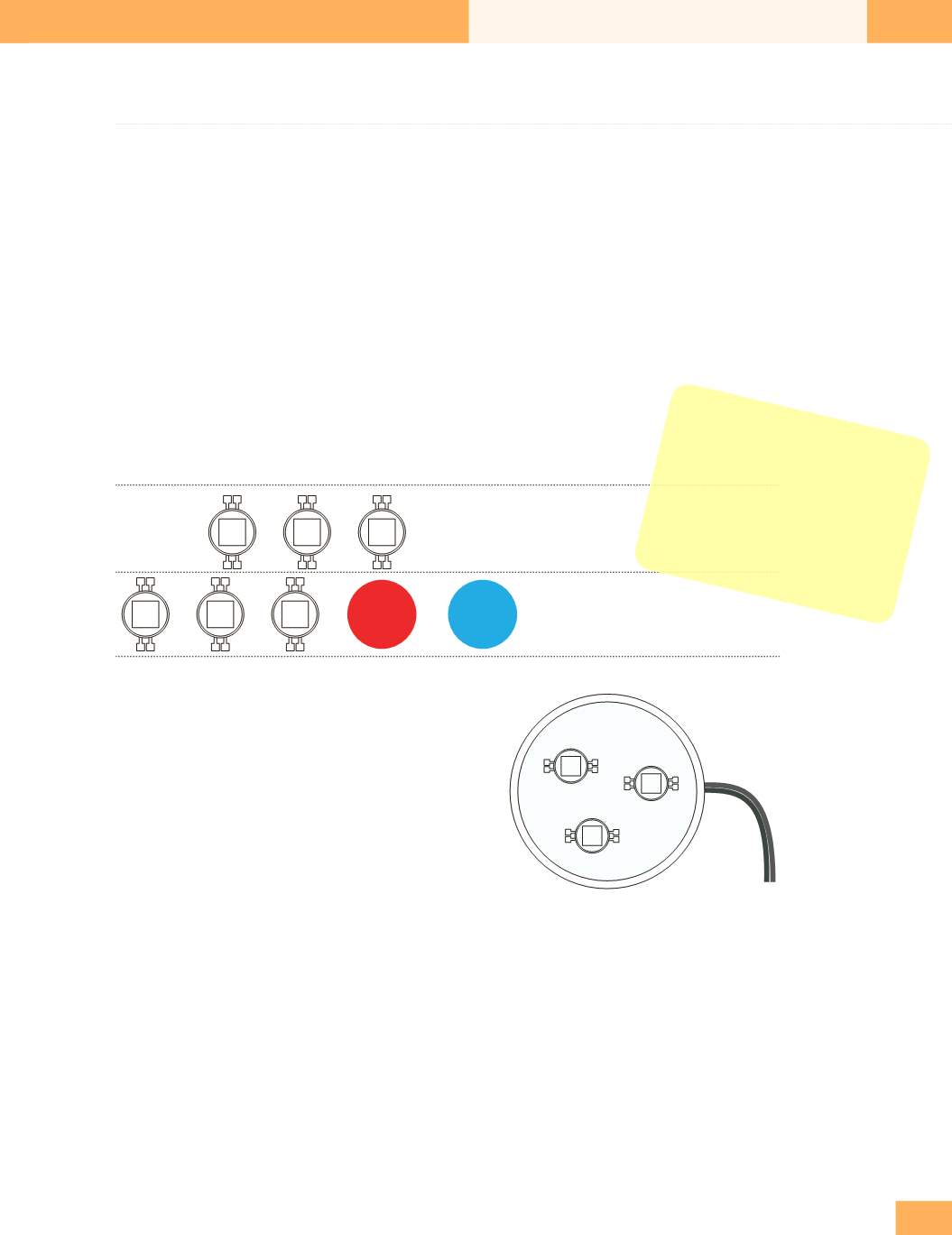
Although the diodes are rated at 400
lumens each, factors such as
heat
and
lenses
will affect the Cold
Lumen Value resulting in a lower
value known as Warm Lumens.
Note:
Actual lumen loss varies with
every lamp design. There is no way to
calculate lumen loss exactly without
the use of an advanced machine
known as an integrating sphere.
The numbers used in this example
are to help convey the concept of
lumen loss only.