


 83 / 105

82
Recommendations for Wheel End Lubrication
TMC RP 622 © 2003 – TMC/ATA – Reprinted with Permission
PREFACE
The following Recommended Practice is subject to the
Disclaimer at the front of TMC’s
Recommended Main-
tenance Practices Manual
. Users are urged to read the
Disclaimer before considering adoption of any portion of
this Recommended Practice.
PURPOSE AND SCOPE
The purpose of this Recommended Practice is to offer
equipment users recommendations and operational con-
siderations for selecting lubricants for use in wheel end
applications. This Recommended Practice applies to
Class 3- 8 trucks, buses, tractors, and trailers designed
for on-highway applications. This Recommended Prac-
tice applies to only “traditionally” equipped axles and
hubs. This Recommended Practice defines “tradition-
ally” equipped axles and hubs as wheel ends equipped
with two single row, widespread, tapered roller bearing
assemblies which are manually adjusted.
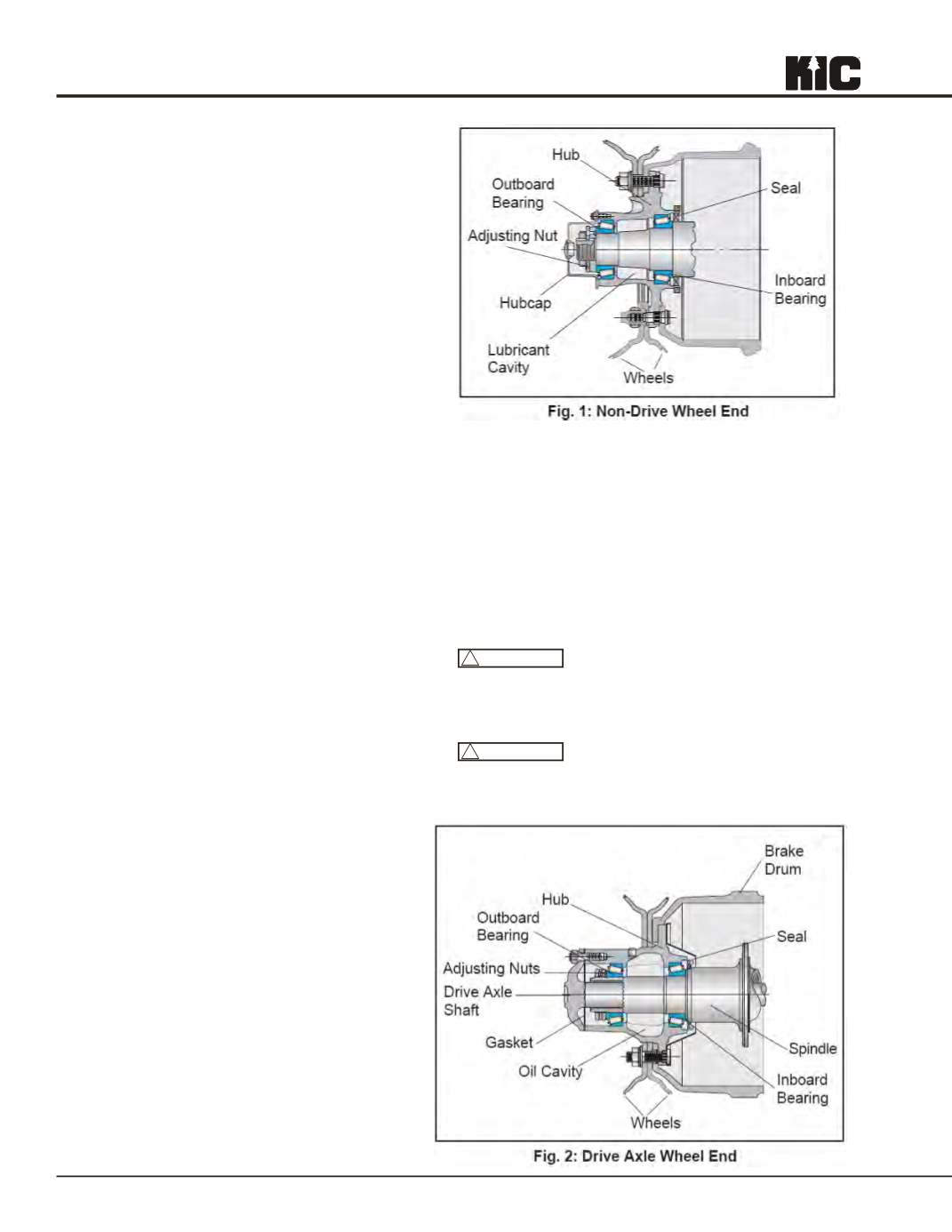
This Recommended Practice addresses two categories
of wheel ends: driven and non-driven. Non-driven wheel
ends include steer, dolly, trailer, pusher and tag axles.
(See
Figures 1
and
2
). The lubricant used in the wheel
ends can be either
petroleum-based
or
synthetic-
based
oils or greases.
REFERENCE
For additional information on wheel bearing adjustment,
installation and maintenance, refer to TMC:
• RP 618,
Wheel Bearing Adjustment Proce-
dures.
• RP 622,
Wheel Seal and Bearing Removal, In-
stallation, and Maintenance.
Other relevant TMC Recommended Practices include:
• RP 624,
Lubricant Fundamentals.
• RP 709,
Hubcap Standardization — Bolted- On
Type.
Fleet managers should also reference original equip-
ment manufacturer (OEM) maintenance and service
manuals as appropriate.
NON-DRIVEN AXLE LUBRICANT
CONSIDERATIONS
Non-driven wheel ends can be lubricated effectively
with either oil or grease, depending on the fleet ap-
plication. Both lubricating substances use oil as the
lubricating medium. (Refer to RP 624,
Lubricant Fun-
damentals for details
.)
A. Non-Driven Oil-Lubricated Wheel Ends
Inspection and Preparation
Clean and inspect the wheel end components includ-
ing
all bearings, hubcaps, hub and bearing cups, axle spin-
dle, and fasteners, removing all contaminants and lu-
bricant residue. Replace seal, hubcap gasket, and all
questionable parts. For detailed procedures, refer to
TMC RP 622.
Component Lubrication
Pre-lubricate the inner and outer wheel bearing cones
with clean lubricant of the same type used in the hub
assembly.
! CAUTION : Failure to lubricate bearing correctly,
and maintain proper lubrication, may result in bearing
damage. For additional information refer to TMC RP 618
and RP 622.
! CAUTION :In oil bath systems, do not pack bear-
ings with grease before installation. Grease will tempo-
rarily restrict or prevent the proper circulation of lubricant
and may contribute to wheel seal failure.